
Free Downloads The Great Transformation: The Beginning Of Our Religious Traditions
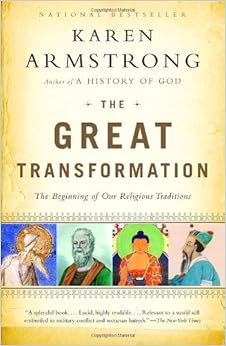


From Karen Armstrong, the bestselling author of A History of God and The Spiral Staircase, comes this extraordinary investigation of a critical moment in the evolution of religious thought.In the ninth century BCE, events in four regions of the civilized world led to the rise of religious traditions that have endured to the present day--the development of Confucianism and Daoism in China, Hinduism and Buddhism in India, monotheism in Israel, and philosophical rationalism in Greece. Armstrong, one of our most prominent religious scholars, examines how these traditions began in response to the violence of their time. Studying figures as diverse as the Buddha and Socrates, Confucius and Jeremiah, Armstrong reveals how these still enduring philosophies can help address our contemporary problems.

Paperback: 592 pages
Publisher: Anchor; Reprint edition (April 10, 2007)
Language: English
ISBN-10: 0385721242
ISBN-13: 978-0385721240
Product Dimensions: 5.2 x 1 x 8 inches
Shipping Weight: 14.4 ounces (View shipping rates and policies)
Average Customer Review: 4.3 out of 5 stars See all reviews (125 customer reviews)
Best Sellers Rank: #116,283 in Books (See Top 100 in Books) #167 in Books > Religion & Spirituality > Religious Studies > Sociology #187 in Books > History > World > Religious > General #281 in Books > Religion & Spirituality > Religious Studies > History

Karen Armstrong spent seven years as a nun, has written 16 previous books about religious matters, and is a prominent commentator on religious affairs in Britain. Her views have changed considerably since her earlier days in the convent, but she maintains tremendous respect for the world's great religions. She is a self-proclaimed "monotheist," but her writings seem to merely support and encourage a spiritual approach toward life - rather than a belief in any deity..."Human beings are spiritual animals...homo sapiens is also homo religiosus."Armstrong's topic in this book is the Axial Age - those seven centuries from 900BCE to 200BCE that were marked by violence and warfare. In four different regions of the world, four great theologies (or ideologies) arose specifically to oppose these violent trends:China - Daoism and ConfucianismIndia - Hinduism and BuddhismPalestine - Judaism, which led to Christianity and IslamGreece - philosophical rationalismIn all four geographical regions, the initial teaching was of tolerance, love, and humane treatment of others - despite the tendency for some of these to evolve into something else. Each tradition formulated its own version of the Golden Rule because what mattered was how one acts - putting ethical behavior at the heart of the spiritual life. The original prophets never relied on dogma - their emphasis was consistently on compassion. "The consensus of these four areas is an eloquent testimony to the unanimity of the spiritual quest of the human race. The Axial peoples all found that the compassionate ethic worked."When secondary prophets or philosophers did start to insist on obligatory doctrines, it was usually a sign that the movement was losing its momentum. In our religious institutions and their dogmas, we are at times creating the exact type of religiosity that the prophets from the Axial Age were trying to get rid of.Armstrong follows the progress of the religious development of the four Axial peoples side by side, charting their progress, sometimes in fits and starts. According to the author, we have never surpassed the insights of the Axial Age. Each generation since has tried to adapt the original insights to their particular situation and that is our task today.The following themes are apparent throughout:1. God is made in man's image rather than the other way around. He is a projection of man's cultural needs, changing as culture evolves, and as new charismatic leaders present themselves.2. Each tradition wrestled with Mythos versus Logos - the more mystical, spiritual, and tolerant approach versus the one more analytical and theological. An emphasis shift from a mystical, unknowable God to a more personal God has its advantages, but tends to allow intolerance and fundamentalism.3. When concentrating on the similarities as to how humanity has always searched for God, they are more obvious than the differences.Armstrong started life with a conservative faith which has changed over the years to a more liberal and mystical one in her quest for God, sans dogma. Many Christians have lived a similar scenario, yet maintained their original beliefs. This book is not a polemic, and I think most people of any faith would not be offended by her approach. In "The Great Transformation," Armstrong is her usual scholarly and convincing self, with insightful comments on every page that would be hard to find elsewhere. "Religion is like a raft," she has said, explaining the Buddhist view of it. "Once you get across the river, moor the raft and go on. Don't lug it with you if you don't need it any more."
The Great Transformation is a history of the Axial Age, the period in the approximate first millenium B.C.E. when nearly all of our present day religions and philosophies were born. The Axial Age was a time when religion and philosophy evolved from the mere worship of something out of fear it could hurt you to a true ethical, compassionate belief. Karen Armstrong is a brilliant writer and thinker, and this is her finest work.In a series of well organized and clearly developed chapters Armstrong traces the development of Zoroastrianism, Judaism, Greek philosophy, Confucianism, Daoism, Hinduism, and Buddhism. Armstrong provides context for the developments of these thought systems by succinctly describing the troubles of the time: invasions, epidemics, and the ebb and flow of cultural diffusion and change. She then relates these problems to the developing thought systems and shows how their influence penetrated the minds of the seers, prophets, and philosophers who were at work throughout the turmoil. Most interestingly, she interconnects the ideas with each other, showing how similar circumstances and contacts created philosophies and religions which shared the same concerns and often advocated many of the same solutions.The Great Transformation should be on the shelves of all who seek to better understand the origins of so much of our human cultural heritage.
This is an outstandingly interesting book, even if you do not agree with every one of Karen Armstrong's conclusions.The great German psychiatrist and philosopher Karl Jaspers first proposed the idea of an "Axial period" that ran from approximately 800 to 200 BCE. During this time all the fundamental creations that underlie our current civilization came into being. It was also during this time that four of the world's great religions and philosophical traditions emerged: Hinduism and Buddhism in India; Confucianism and Taoism in China; Monotheism in Israel, that eventually gave expression to Judaism, Christianity and Islam; and rationalism in Greece. Some experts - including Jaspers - included a fifth: Zoroastrianism in Persia. Most scholars now consider that Zoroastrianism emerged before the Axial period, so it is discussed in this book, but is not one of the four great strands.Following Jaspers' lead, Karen Armstrong credits this six to seven hundred year period as the turning point in the development of human spiritual consciousness. She describes these developments as a reaction to political disintegration and religious intolerance that lead large numbers of people to turn away from their customary systems of ritual and worship, and instead to search for and to create new systems based on justice, compassion and love. This search provided the catalyst for major transformations in religious culture.Though she is a scholar, Karen writes a clear and easily digestible account about the spiritual heart of each of these religious doctrines, and shows that they all have some things in common: primarily the need for compassion and love in overcoming violence, hatred and selfishness. All the great sages of the time from Socrates to some of the Old Testament prophets, the mystics of the Upanishads and the Buddha taught the central importance of personal responsibility and self-criticism, which had to be followed by practical. effective action.Although a great step forward, the emergence of the ethics and religions of the Axial period was far from perfect. As the most glaring example, women were largely excluded from a significant place in most of these systems.Karen's approach also begs another question: did religions emerge as a reaction to the times or had some people reached a point in their development where they were able to receive Divine guidance?It is easy to see many of the parallels between the Axial period and the turmoil of today. Perhaps a return to the ethos of the time, in an evermore interconnected world, armed now with the cognitive and emotional insights of the last two thousand years, might help provide the guidelines for another great step forward along the spiritual path. And a way of dealing with some of the problems that threaten to engulf us.As Karen Armstrong say, "In the last resort, "love" and "concern" will benefit everybody more than self-interested or shortsighted policies."This book makes for absorbing and inspirational reading, and shows the importance of returning to the roots of our different faiths.Highly recommended.

The Great Transformation: The Beginning of Our Religious Traditions Zoroastrians: Their Religious Beliefs and Practices (The Library of Religious Beliefs and Practices) The Nourishing Traditions Cookbook for Children: Teaching Children to Cook the Nourishing Traditions Way Cultural Traditions in Iran (Cultural Traditions in My World) Cultural Traditions in Mexico (Cultural Traditions in My World) Inheritance: How Our Genes Change Our Lives--and Our Lives Change Our Genes The Mind-Gut Connection: How the Hidden Conversation Within Our Bodies Impacts Our Mood, Our Choices, and Our Overall Health The World's Religions: Our Great Wisdom Traditions Beginning Python Visualization: Crafting Visual Transformation Scripts (Books for Professionals by Professionals) Recalling Our Own Stories: Spiritual Renewal for Religious Caregivers Sacred Rhythms: Arranging Our Lives for Spiritual Transformation Callie's Biscuits and Southern Traditions: Heirloom Recipes from Our Family Kitchen The Illustrated World's Religions: A Guide to Our Wisdom Traditions Living as United Methodist Christians: Our Story, Our Beliefs, Our Lives Pornified: How Pornography Is Transforming Our Lives, Our Relationships, and Our Families GlobalChurch: Reshaping Our Conversations, Renewing Our Mission, Revitalizing Our Churches The Beginning Band Fun Book's FUNsembles: Book of Easy Duets (French Horn): for Beginning Band Students The Beginning Band Fun Book's FUNsembles: Book of Easy Duets (Trombone): for Beginning Band Students Beginning Tennis (Beginning Sports) Beginning JavaScript with DOM Scripting and Ajax: From Novice to Professional (Beginning: From Novice to Professional)
