
Free Downloads Reality Hunger: A Manifesto
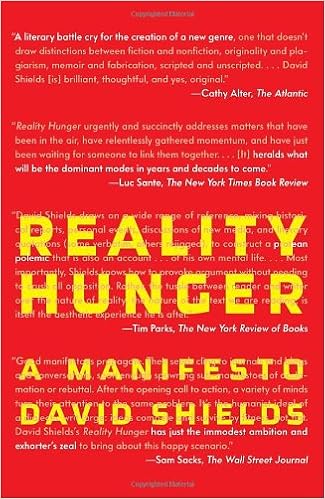


With this landmark book, David Shields fast-forwards the discussion of the central artistic issues of our time. Who owns ideas? How clear is the distinction between fiction and nonfiction? Has the velocity of digital culture rendered traditional modes obsolete? Exploring these and related questions, Shields orchestrates a chorus of voices, past and present, to reframe debates about the veracity of memoir and the relevance of the novel. He argues that our culture is obsessed with “reality,” precisely because we experience hardly any, and urgently calls for new forms that embody and convey the fractured nature of contemporary experience.

Paperback: 240 pages
Publisher: Vintage; unknown edition (February 8, 2011)
Language: English
ISBN-10: 0307387976
ISBN-13: 978-0307387974
Product Dimensions: 5.2 x 0.9 x 8 inches
Shipping Weight: 8.8 ounces (View shipping rates and policies)
Average Customer Review: 4.0 out of 5 stars See all reviews (88 customer reviews)
Best Sellers Rank: #99,860 in Books (See Top 100 in Books) #3 in Books > Literature & Fiction > History & Criticism > Movements & Periods > Modernism #50 in Books > Politics & Social Sciences > Philosophy > Aesthetics #528 in Books > Literature & Fiction > Essays & Correspondence

1. Despite this book's praise for collage and appropriation, cutting passages from the jacket copy and/or Shields' own description of the book, then pasting as a five-star review, isn't valuable in any way.2. Speaking of the jacket copy, by writing a negative review of this book it seems I will be "defending the status quo." Always useful to caricature your opponents in advance. And I thought the status quo totally depressed me ...3. What is this "conventional literary novel" Shields keeps talking about? Yeah, I also have no desire to read Olive Kittredge, but my lack of interest in the latest celebrity memoir hardly discredits the genre of memoir as a whole. Is Shields reading Hemon, Javier Marias, Percival Everett, Kathryn Davis? For someone who persuasively writes of the novel as a hybrid genre and wants to stake out an indefinite space for his own work, Shields really likes drawing lines in the sand.4. When Shields does admire a fiction writer (i.e. Bernhard, Coetzee, Sebald) he pretends the writer is a sort of essayist in disguise. This is bizarre. All of the above writers create imaginary characters and involve them in invented narratives. Photos in Sebald do not make him a documentarian. The reason their books do not seem like fiction is that they are incredibly well executed, that is to say artistic. Fiction that does not seem like fiction is simply good fiction. Shields can't admit that the magic is working.5. How can a book about reality-based forms of art and writing not mention historical fiction even once? Is it because historical fiction sounds staid and proves that Shields' ideas aren't as new and exciting as they want to be? Anybody remember postmodernism, by the way?6. "Elizabeth Costello," a book Shields recommends several times, would surely create much less cross-genre frisson (would be much less interesting in Shields' own terms) if it was just a series of lectures, if it didn't have its so-called fictional rigging. The fictional elements of it are what create the epistemological uncertainty -- a fact that was certainly remarked upon when Coetzee delivered the stories as lectures at universities.7. It's funny that a writer tries to be au courant by citing 40-50-year-old quotes announcing the death of fiction. Doesn't this undermine the case a little? No doubt he's right ... about fiction's irrelevance to the culture, anyway, but surely it will be displaced by more meaningless chatter, social networking, and noise, not the lyric essay. Actually this book seems to be in many ways a manifesto for the blogosphere. I kept thinking, blogs are what you want to read, man. Brevity, appropriation, truthiness, the self in all its mangy glory.8. The part where he tells his writer friends what their books are really about is insufferable. Even the original recipients must have winced when they got these letters, and it is painful to eavesdrop on them. The chapter is of a piece with Shields' bewildering theory that fiction has a sort of extractable essence. If only Ballard did away with all those drained swimming pools and crashed cars and told us what he really meant about technology and modernity! If only Kafka cut the atmospherics and philosophized! Surely Shields thinks "The Zurau Aphorisms" is Kafka's best book.9. I realize I am getting carried away here. This is to Shields' credit. He has not instructed but provoked my soul, to paraphrase him paraphrasing Emerson. Ultimately this is a book about the lit David Shields likes, which is stuff I also like. I don't define it the way he does. I resent the sophistries and the posturing. I suspect his argument against fiction is more personal than I understand, much like Franzen's jeremiad against difficult books. But the aesthetics here seem pretty egocentric and narrow in the end. (When you read a novel you are participating in someone else's imagined reality, and it amazes me that someone so averse to this generous, beautiful act would comment on fiction at all.) However, "Reality Hunger" is a seriously intended book and it should provoke a serious debate. Let's stop essentially blurbing this book -- it's been blurbed more than enough already -- and actually discuss it.
"Reality Hunger: a Manifesto" combines extreme intelligence with extreme silliness, tiresome tech-savvy, and self-regarding irony. The result is as tiresome as the character-drive epic novels the author quite rightly disdains. Reading the book is like being held captive by a half-drunk, know-it-all, newly tenured professor holding court at a grad school after-party. He's read everything, knows more than you do, and is bound and determined to bore you to death with every excruciating aside. He loves himself and wants you to love him too. So much of what the author says in this book (published 2010) already sounds outdated and even passé.
I don't know Shields's other books, but based on this one, I'd say he's an ambitious, and pretentious, lightweight. Like many another failed or stalled novelist before him, Shields tries to do an end run around the problem of creating something of value by emitting a "manifesto" of How Literature Should Be. Beware of blowhards bearing rules. He doesn't define his terms clearly, and often his ideas, such as they are, are mutually contradictory.It boils down to this: he finds traditional narrative boring. He's bored reading it, and, perhaps more significantly, he is bored writing it. He talks about how bored he is with the "traditional form of the novel," as if there is such a thing in a genre that includes "Don Quixote," "Tristram Shandy," "War And Peace," "Nightwood," "Middlemarch," "Bleak House," and any ten other good novels you might name.This is a gimmicky and ultimately pathetic book, in my opinion. There are already all kinds of genre-bending books out there -- "The Unquiet Grave," by Cyril Connolly, any of Lydia Davis' books, Nicholson Baker's "Vox," "Operation Shylock" by Philip Roth... I mean you could go on all day with such a list. None of these writers needed David Shields to give them permission to do whatever the hell they wanted at the writing desk. This book is basically a desperate and opportunistic attempt by an intellectual poseur to claim some shelf space next to his intellectual betters. Sorry, but that's how I read it.But if you'd like a much more cut-to-the-chase opinion, check out Shields's appearance on the Colbert Report from mid-April. Colbert (literally) tears him a new one. See how seriously you can take him after his unctuous, self-inflated performance here:[...]

Reality Hunger: A Manifesto The World of the Hunger Games (Hunger Games Trilogy) The Unofficial Hunger Games Cookbook: From Lamb Stew to "Groosling" - More than 150 Recipes Inspired by The Hunger Games Trilogy (Unofficial Cookbook) The Hunger Games (Hunger Games Trilogy, Book 1) The Power of Broke: How Empty Pockets, a Tight Budget, and a Hunger for Success Can Become Your Greatest Competitive Advantage The Hunger Games Tribute Guide The Hunger Games: Official Illustrated Movie Companion Hunger of Memory : The Education of Richard Rodriguez The American Paradox: Spiritual Hunger in an Age of Plenty Hunger: An Unnatural History The Hunger Games The Hunger Games (Book 1) The Hunger Games Box Set: Foil Edition Catching Fire |Hunger Games|2 Mockingjay: The Final Book of The Hunger Games Mockingjay (The Hunger Games) The Hunger Games Trilogy Boxed Set Poverty and Hunger (Mapping Global Issues) Hunger Makes Me a Modern Girl: A Memoir Catching Fire: Hunger Games, Book 2
