
Free Downloads The Night Battles: Witchcraft & Agrarian Cults In The Sixteenth & Seventeenth Centuries
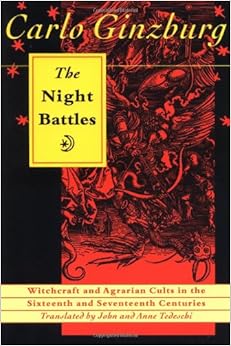


Based on research in the Inquisitorial archives, the book recounts the story of a peasant fertility cult centred on the benandanti. These men and women regarded themselves as professional anti-witches, who (in dream-like states) apparently fought ritual battles against witches and wizards, to protect their villages and harvests. If they won, the harvest would be good, if they lost, there would be famine. The inquisitors tried to fit them into their pre-existing images of the witches’ sabbat. The result of this cultural clash which lasted over a century, was the slow metamorphosis of the benandanti into their enemies – the witches. Carlo Ginzburg shows clearly how this transformation of the popular notion of witchcraft was manipulated by the Inquisitors, and disseminated all over Europe and even to the New World. The peasants’ fragmented and confused testimony reaches us with great immediacy, enabling us to identify a level of popular belief which constitutes a valuable witness for the reconstruction of the peasant way of thinking of this age. --This text refers to an out of print or unavailable edition of this title.

Paperback: 232 pages
Publisher: Johns Hopkins University Press; 5th edition (March 1, 1992)
Language: English
ISBN-10: 0801843863
ISBN-13: 978-0801843860
Product Dimensions: 6 x 0.6 x 9 inches
Shipping Weight: 12.6 ounces
Average Customer Review: 4.5 out of 5 stars See all reviews (18 customer reviews)
Best Sellers Rank: #53,683 in Books (See Top 100 in Books) #23 in Books > History > Historical Study & Educational Resources > Historiography #24 in Books > Literature & Fiction > Mythology & Folk Tales > Mythology #40 in Books > History > Europe > Italy

As anthropologists fanned around the world they brought back detailed accounts of shamanic practices of indigenous peoples from Africa, Asia, Siberia & Native America - but not from Europe. European shamanism (including druidism) is thought to have been largely stamped out due to the combined efforts of Enlightenement and the Holy Inquisition. The book opens up the question of the many similarities between Germanic, Latin, Slavic agricultural cults and their relationship to the Dionysian rituals as well as the issue of universality of core beliefs that underly indigenous practices around the world.The book also pioneers a new understanding of Europeans and their history - one that focuses on the peasant and his relationship with the land (and the Church). The aristocratic elite that controlled the politics and religion of mediaeval Italian city states was just a tiny fraction of the population; Ginzburg therefore opens up a new (and should i say delicious) can of worms. This book represents a huge step forward in our understanding of European shamanism. Ginzburg burrows deep into the 16th century Inquisition archives from the Friuli region of Northern Italy (where Latin, Slavic and Germanic traditions come together). He returns with a fascinating discovery of an ancient fertility cult, whose participants (the benandanti) represented themselves as defenders of harvest and fertility of the fields. A benandante was someone who four times a year during the Ember days left the body and went "invisibly in spirit" to fight the witches and the devil - "we fight over all the fruits of the earth and for those things won by the benandanti that year there is abundance", said a peasant while questioned by the Inquisition.
Whether or not Carlo Ginzburg actually discovered evidence of shamanism in sixteenth-century Italy, in this or later books, is in part a matter of how one defines shamanism. What he undeniably found, in the seemingly unpromising records of the Inquisition, was evidence of beliefs so remote from those of official European culture as to be flatly unintelligible to the churchmen who first encountered them. Eventually, the Church courts managed to impose something resembling officially acceptable doctrines on the local population, but the process took generations, as Ginzburg is able to show from trial records.Briefly, Ginzburg found that, in the Friuli district, there was a widespread belief that certain men and women were marked at birth as defenders against witches and demons, these being regarded mainly as the enemies of the people, their livestock, and their crops. The chosen defenders, the "Benandanti," or "good walkers," ventured forth in their dreams to do battle with the forces of evil. Those born with the mark of the Benandanti regarded themselves as good Christians, the allies of the Church. To those outside the local culture, this position was clearly nonsense; unauthorized and unsanctified supernatural power could only be Satanic in origin, and those who claimed to exercise it were, at best, dangerously deluded. In the end, if the court records are to be trusted, they persuaded even the Benandanti themselves that this was the case. At least, the "absurd" and "outrageous" testimony of self-described Benandanti fades from the records, to be replaced with conventional witch-beliefs endorsed by the Holy Office.
In his book, The Night Battles, Carlo Ginzburg addresses the historical problem of why, during sixteenth and seventeenth centuries, did the Friulian fertility rituals of the benandanti, or "good-walkers", gradually assimilate into witchcraft. The benandanti, marked at birth by the sign of the caul, served Christ and their community by leaving their bodies at night to fight evil witches that had attempted to destroy or steal their harvest. Because of the ignorance of the Friuli language and benandanti rituals, the Church conducted incessant inquisitions and trials against the self-proclaimed benandanti, which in effect, pushed the benandanti toward witchcraft and participation in the sabbat.In support of this argument, Ginzburg employs inquisitorial records that reveal an unmistakable gap between the beliefs and mentalities of the benandanti with those of the inquisitors. Brian P. Levak's review, published in the Journal of Interdisciplinary History, notes the significance of Ginzburg's exploration of the mentalities and culture of the Friuli. Levak writes, "The Night Battles is a milestone in the history of popular culture, for it was one of the first studies to use judicial records to gain direct access to popular beliefs." In addition, by skillfully using his primary source material, Ginzburg is able to discern between the "genuinely expressed popular ideas and those that reflect the more learned notions of [the] interrogators, especially when the accused was faced with either the threat or the reality of torture." To Ginzburg's credit, he allows the strength of the inquisitorial records to stand alone in support of his thesis and in exposing the popular culture of the Friuli.

The Night Battles: Witchcraft & Agrarian Cults in the Sixteenth & Seventeenth Centuries The Norton Anthology of English Literature, Volume B: The Sixteenth Century/The Early Seventeenth Century The Visions of Isobel Gowdie: Magic, Witchcraft and Dark Shamanism in Seventeenth-Century Scotland Green Witchcraft: Folk Magic, Fairy Lore & Herb Craft (Green Witchcraft Series) Twenty-four Italian Songs and Arias of the Seventeenth and Eighteenth Centuries for Medium Low Voice (Schirmer's Library of Musical Classics, Vol. 1723) (English and Italian Edition) Twenty-Four Italian Songs & Arias of the Seventeenth and Eighteenth Centuries: Medium High Voice (Schirmer's Library of Musical Classics, Vol. 1722) (Italian and English Edition) Scripture, Culture, and Agriculture: An Agrarian Reading of the Bible Every Twelve Seconds: Industrialized Slaughter and the Politics of Sight (Yale Agrarian Studies Series) Chicken: The Dangerous Transformation of America’s Favorite Food (Yale Agrarian Studies Series) The Sacred Mushroom and The Cross: A study of the nature and origins of Christianity within the fertility cults of the ancient Near East The Kuřim Case: A Terrifying True Story of Child Abuse, Cults & Cannibalism Diet Cults: The Surprising Fallacy at the Core of Nutrition Fads and a Guide to Healthy Eating for the Rest of Us The Kuřim Case: A Terrifying True Story of Child Abuse, Cults & Cannibalism (True Crime) Christian Science: What Do They Believe? (Cults and Isms Book 3) Jehovah's Witnesses: What Do They Believe? (Cults and Isms Book 6) Mary Higgins Clark; The Night Collection (Silent Night & All Through the Night) [Abridged, Audiobook] [Audio CD] American Electricians' Handbook, Sixteenth Edition Seeds in the Heart: Japanese Literature from Earliest Times to the Late Sixteenth Century The Cheese and the Worms: The Cosmos of a Sixteenth-Century Miller The Palaeography of Gothic Manuscript Books: From the Twelfth to the Early Sixteenth Century
