
Free Downloads Impossible Subjects: Illegal Aliens And The Making Of Modern America (Politics And Society In Modern America)
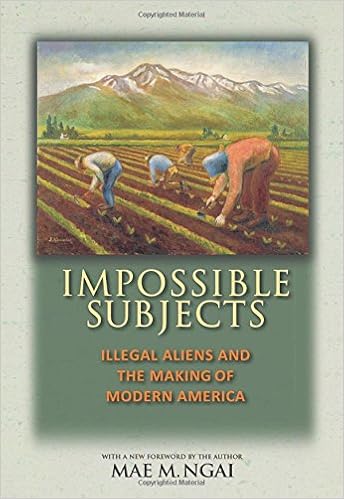


This book traces the origins of the "illegal alien" in American law and society, explaining why and how illegal migration became the central problem in U.S. immigration policy--a process that profoundly shaped ideas and practices about citizenship, race, and state authority in the twentieth century. Mae Ngai offers a close reading of the legal regime of restriction that commenced in the 1920s--its statutory architecture, judicial genealogies, administrative enforcement, differential treatment of European and non-European migrants, and long-term effects. She shows that immigration restriction, particularly national-origin and numerical quotas, remapped America both by creating new categories of racial difference and by emphasizing as never before the nation's contiguous land borders and their patrol.

Series: Politics and Society in Modern America
Paperback: 416 pages
Publisher: Princeton University Press; Updated edition with a New Foreword edition (April 27, 2014)
Language: English
ISBN-10: 0691160821
ISBN-13: 978-0691160825
Product Dimensions: 6 x 1 x 9.2 inches
Shipping Weight: 1 pounds (View shipping rates and policies)
Average Customer Review: 3.9 out of 5 stars See all reviews (12 customer reviews)
Best Sellers Rank: #36,682 in Books (See Top 100 in Books) #9 in Books > History > Americas > United States > Immigrants #33 in Books > Politics & Social Sciences > Social Sciences > Emigration & Immigration #81 in Books > Politics & Social Sciences > Social Sciences > Specific Demographics > Ethnic Studies

Mae Ngai's ambitious book compels historians and general readers alike to critically reassess traditional understandings of and approaches to U.S. immigration. Much of the histories on U.S. immigration and immigration policies have told a similar tale. The United States, the narrative goes, has been tainted by a long history of exclusion, a blight on the nation's democratic tradition that was only recently removed with the passage of the Immigration Act of 1965. Such a narrative not only reaffirms the myth of American universalism, but also consistently fails to produce any new critical knowledge about U.S. immigration and U.S. history. Impossible Subjects differs from these other works of immigration history in this important respect: it proceeds with the conviction that the United States was never a "nation of immigrants."Ngai examines the era between 1924 and 1965, an unconventional periodization in immigration history that situates the 1924 Johnson-Reed Act (usually signifying the end of one regime) at the beginning of her study, and the Immigration Act of 1965 (usually signifying the beginning of another) at the end. Beyond simply filling a historiographical gap in immigration history, the focus on this period of immigration restriction enables a reevaluation of U.S. immigration laws, and more broadly of U.S history, on several levels. First, it demonstrates that restrictionist policies did not merely function as a tool for exclusion, but more, it created-through a racial and geographical remapping of the nation-new categories and concepts deeply implicated in race that defined the spaces and limits of national inclusion. Second, these categories and concepts, most notably "illegal aliens" and "national origins," are not natural or fixed conditions and markers, but are the product of positive law that, when scrutinized, reveal the ways in which its uses have shaped and defined the United States in the twentieth century, particularly its ideas and practices about race, citizenship, and the nation-state. Finally, this periodization allows for a reconfiguration of immigration history beyond a nationalist framework. By suggesting that the making of modern America rested on the exclusion of nonwhites from the geographical and ideological borders of the nation during this regime of restriction, the book argues against the normative telos of immigrant settlement, assimilation, and citizenship as the defining narrative of American history, a narrative that is confined to the nation-state and that invariably reproduces American exceptionalism.By charting the historical origins of the "illegal alien" and the genealogy of immigration laws that have consistently reproduced it, Ngai has ultimately written a stunning history that goes far beyond narrating the history of U.S. immigration restriction. It is a book that deserves to be read widely.
IMPOSSIBLE SUBJECTS, written by Mae Ngai, is the best of recent books on the 20th-century American history of immigration. She reveals that the problem of "illegal immigrants," which has been regarded as one of the most serious problems since the late 20th century, is indeed a legal construction. According to the author, immigrants from Mexico were drawn into the U.S. Southeast because the Southeast political economy, especially agri-business, raised need for the massive wave of low-wage immigrant workers and at the same time defined them as the racially "foreign" people who were rendered alien to America, which was defined as the nation of Caucasians. What enabled the American Government and people to attach racialized foreignness to the Mexican immigrants (and, inevitably, American citizens of Mexican origin) were Immigration Acts, border policing, and discriminatory control of visas.Mae Ngai argues that positive laws concerning immigration policy have constructed the category of "illegal aliens" from Mexico, and the implementation of the laws by Border Patrols and INS has reinforced the labeling of racially alien immigrants. She bases her analysis on the critical legal theory which suggests that laws constitute social formations. Her usage of the new legal theory in her inquiry into the American immigration history is highly excellent and persuasive.The historical analysis of the immigration problems in this book seems to be applicable to other countries' history. For example, Ngai's insight shall give light to the recent Japanese conservative media discourses on the "illegal migrants" from China, South Korea, and Latin American nations which describe the undocumented migrant workers as illegal, criminal and, in case of women, prostitutes.I would have dedicate five stars to this book if its text were easier to read (it is possible that I felt this book's text not very easy to read because I am not of a native-English tongue).

Impossible Subjects: Illegal Aliens and the Making of Modern America (Politics and Society in Modern America) Impossible Subjects: Illegal Aliens and the Making of Modern America (Politics and Society in Twentieth-Century America) Coyotes: A Journey Across Borders With America's Illegal Aliens Funny Aliens: 36 Funny Doodles of Aliens and Animals to Make Your Day (Stress-Relief & Meditation) Debtor Nation: The History of America in Red Ink (Politics and Society in Modern America) Making the Modern American Fiscal State: Law, Politics, and the Rise of Progressive Taxation, 1877-1929 (Cambridge Historical Studies in American Law and Society) Cloud of the Impossible: Negative Theology and Planetary Entanglement (Insurrections: Critical Studies in Religion, Politics, and Culture) Trespassing Across America: One Man's Epic, Never-Done-Before (and Sort of Illegal) Hike Across the Heartland Joe's Law: America's Toughest Sheriff Takes on Illegal Immigration, Drugs and Everything Else Crossing the BLVD: Strangers, Neighbors, Aliens in a New America American Babylon: Race and the Struggle for Postwar Oakland (Politics and Society in Modern America) Coaching for Breakthrough Success: Proven Techniques for Making Impossible Dreams Possible The Invisible Crime: Illegal Microchip Implants and Microwave Technology and Their Use Against Humanity Fairer Fishing?: The Impact on Developing Countries of the European Community Regulation on Illegal, Unreported and Unregulated Fisheries (Economic Paper Series) Unexplained Mysteries: Ancient Aliens Or Lost Technology?: The Missing Tech Behind The World's Greatest Structures (UFOs, ETs, and Ancient Engineers Book 1) No One Is Illegal: Fighting Racism and State Violence on the U.S.-Mexico Border Illegal People: How Globalization Creates Migration and Criminalizes Immigrants Sugar Skulls at Midnight Adult Coloring Book : Volume 2 Animals & Aliens: A Unique Midnight Edition Black Background Paper Adult Coloring Book For Men ... Relaxation Stress Relief & Art Color Therapy) Aliens are Coming! (Dragonfly Books) Aliens Are Coming!: The True Account Of The 1938 War Of The Worlds Radio Broadcast
