
Free Downloads Alone With The Alone
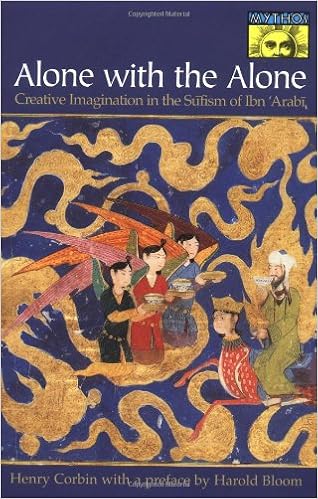


"Henry Corbin's works are the best guide to the visionary tradition.... Corbin, like Scholem and Jonas, is remembered as a scholar of genius. He was uniquely equipped not only to recover Iranian Sufism for the West, but also to defend the principal Western traditions of esoteric spirituality."--From the introduction by Harold BloomIbn 'Arabi (1165-1240) was one of the great mystics of all time. Through the richness of his personal experience and the constructive power of his intellect, he made a unique contribution to Shi'ite Sufism. In this book, which features a powerful new preface by Harold Bloom, Henry Corbin brings us to the very core of this movement with a penetrating analysis of Ibn 'Arabi's life and doctrines.Corbin begins with a kind of spiritual topography of the twelfth century, emphasizing the differences between exoteric and esoteric forms of Islam. He also relates Islamic mysticism to mystical thought in the West. The remainder of the book is devoted to two complementary essays: on "Sympathy and Theosophy" and "Creative Imagination and Creative Prayer." A section of notes and appendices includes original translations of numerous Su fi treatises.Harold Bloom's preface links Sufi mysticism with Shakespeare's visionary dramas and high tragedies, such as The Tempest and Hamlet. These works, he writes, intermix the empirical world with a transcendent element. Bloom shows us that this Shakespearean cosmos is analogous to Corbin's "Imaginal Realm" of the Sufis, the place of soul or souls.

Series: Bollingen Series (General)
Paperback: 440 pages
Publisher: Princeton University Press (March 2, 1998)
Language: English
ISBN-10: 0691058342
ISBN-13: 978-0691058344
Product Dimensions: 9.2 x 6.1 x 1 inches
Shipping Weight: 1.3 pounds (View shipping rates and policies)
Average Customer Review: 4.5 out of 5 stars See all reviews (28 customer reviews)
Best Sellers Rank: #446,490 in Books (See Top 100 in Books) #151 in Books > Religion & Spirituality > Islam > Sufism #560 in Books > Religion & Spirituality > Other Religions, Practices & Sacred Texts > Mysticism

One of the best books on esoteric Persian thought I've ever read; immensely scholarly and yet largely readable, though very rich and thick with insight in places you'll want to slow down and really absorb. (A newcomer to Ibn 'Arabi's writings, I'm reviewing this book from a depth-psychological point of view.)If you've read my other reviews you know I'm a relentless critic of unreadable writing, much of which is symptomatic of a narcissistic unavailability better dealt with in therapy than through a publisher or fan club. Corbin is not easy to follow in places, but it's the concentration of the material that makes for more careful study--and makes more careful study worthwhile.I was particularly moved by the image of the saddened God breathing out a sigh at being unknown, a sigh that made space for humans to reflect God back to God and thereby become the "secret treasure." Corbin's criticism of "becoming one with God" mirrors Buber's of "doctrines of absorption": both praise a dialog between person and the Divine rather than a reduction of one to the other.Note to students of James Hillman: while many of Hillman's ideas can be found here (the heart as an organ of soulful perception, for instance), Ibn 'Arabi makes a clear, non-Hillmanic distinction between Forms (Images) of God and the ineffable true God that shines through the Forms like light through stained glass. This distinction does not exist for archetypal psychology, which collapses the archetypal image into the archetype itself and regards extra-psychic activities as outside its purview.
I have noticed that there are a few Sunni/wahabi types who are reviewing this book and giving it low ratings. Since they have already condemned Arabi, and sufism before they have understood either, I fail to see what value their reviews could be. Instead of a critique of this book, or Arabi on their own merits, these individuals merely compare it to Shi'a Islam. Let me tell you this: if you are looking for a book to re-confirm your fundamentalist beliefs in any religion, this book, sufism and mysticism as a whole are not for you, so don't waste your time reading or reviewing these books. On the other hand, if you're the sort of individual who wishes to experience God directly, through the heart, and without the idolatrous worship of scriptural dogma and the snares of the intellect, then this book, Arabi and the works of other great sufi writers and poets are meant for you. I say this to all people, regardless of what religion they are, or if they even have a religion at all.The only thing which might be better than reading this book, is reading Arabi himself. This is a useful introduction to a vast field, that gives a careful analysis to his ideas and therefore it is a must. I will have to re-read it, to get everything out of it and at that time I may change my rating.
Ibn `Arabî was one of the greatest and (still) most controversial figures in the history of Islam. Familiar categories don't fit him. Philosopher, theologian, saint, mystic, Kabbalist: he was a bit like all of these but not exactly any of them. William Blake is his only close Western counterpart, but Blake was a changeling, a one-off, while Ibn `Arabî was a devout Muslim: strictly observant, given to fasting, prayer, solitary retreats, pilgrimage, immersion in the Qur`an.He moved in a radiant atmosphere unknown to most of us; he saw visions the way other people sneeze; Qur`anic verses became spirits who protected him. His writings are poetic, recondite, startling, naïve, uncategorisable, full of Qur`anic references and dream-images (no-one had ever told his unconscious mind it was supposed to be unconscious.)Despite his vast influence on Islam, his prodigious output is only beginning to be translated. This book is the best introduction, but requires caution. It is one of the most wonderful and exasperating books in existence: it presents ideas so exciting they make your ears pop, but in a turbid professorial style that makes reading like swimming backwards through treacle.Corbin also approaches his subject through his own preoccupations, derived from the crisis of Western philosophy in the early 20th century: Islamic concepts of non-empirical knowledge showed him the way out of the impasse. Thus the book has been criticised as one-sided; as half Ibn `Arabî, half Corbin. Yet William Chittick's model study ("The Sufi Path of Knowledge") seems trimmed and academic beside Corbin's passionate engagement.Here you can read of prayer that creates its object; of the mutual discovery of the Infinite and the finite; of realms of Imagination more real than material things; of angels who exist because we speak with them. This is the door to a world of wonders; prepare to be turned upside-down.
This is an important study of imagination in Ibn Arabi by a significant philosopher-Orientalist. Corbin differentiates imagination from mere "fantasy," an "exercise of thought without foundation in nature." Thus what he has in mind when speaking of imagination is quite different from what we usually associate with the term. Cosmic Imagination is the creative power that gives birth to the sensory world: God imagines the cosmos and brings it into being. Imagining is a creative act which at the Divine level is a form of genesis where God draws out existence from Himself. This view stands in contrast to creation ex nihilo, a theological view partly responsible, in Corbin's view, for the degeneration of imagination into fantasy. But it is not only God who creates through Imagination, but man as well. The God that man creates is a theophony of man's active imagination, which is merely an organ of "absolute theopanic Imagination" (takhayyl mutlaq). This is another way of saying that God imagines Himself or rather creates an image of Himself through man, and that this imagining is a part of a larger Divine Imagination. No two images of God created by mortal imagination are exactly alike.Most of the work is based on Ibn Arabi's Fusus al-Hikam, but as Chittick has noted, determining where Ibn Arabi ends and Corbin begins is not a simple task.

The Last Lion: Winston Spencer Churchill, Volume II: Alone, 1932-1940: Winston Spencer Churchill, Volume II: Alone, 1932-1940 Alone Yet Not Alone: Their faith became their freedom Alone with the Alone Honor Bound & Two Alone: Honor Bound, Two Alone The Lonely City: Adventures in the Art of Being Alone Alone on the Wall Not Alone Wait: A Bleeding Stars Stand-Alone Novel Alone Together: Why We Expect More from Technology and Less from Each Other When You Ride Alone You Ride with bin Laden: What the Government Should Be Telling Us to Help Fight the War on Terrorism DK Readers: The Story of Anne Frank (Level 3: Reading Alone) George Washington -- Soldier, Hero, President (DK Readers, Level 3: Reading Alone) They Stood Alone!: 25 Men and Women Who Made a Difference Lost Trail: Nine Days Alone in the Wilderness A Smart Girl's Guide: Staying Home Alone (Revised): A Girl's Guide to Feeling Safe and Having Fun DK Readers: Survivors -- The Night the Titanic Sank (Level 2: Beginning to Read Alone) When We Were Alone DK Readers: Plants Bite Back! (Level 3: Reading Alone) The Secret Life of Trees, Level 2: Beginning to Read Alone (DK Readers) Not by Faith Alone: A Biblical Study of the Catholic Doctrine of Justification
