
Free Downloads The Historian's Craft: Reflections On The Nature And Uses Of History And The Techniques And Methods Of Those Who Write It.
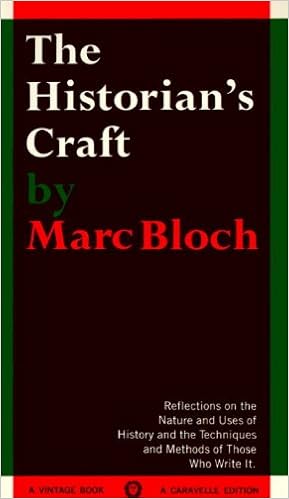


This book is his (Marc Bloch) testament as a historian - a thoughtful, honest statement by a great craftsman about the principles of his trade. here he expressed his aims, which were those of most historians of his own and younger generations. here he set forth his conviction of hte unity of all history and of the living connection between present and past which makes history something more than a game for dilettantes.

Mass Market Paperback: 197 pages
Publisher: Vintage; 59500th edition (March 12, 1964)
Language: English
ISBN-10: 0394705122
ISBN-13: 978-0394705125
Product Dimensions: 4.2 x 0.6 x 6.9 inches
Shipping Weight: 4 ounces (View shipping rates and policies)
Average Customer Review: 4.5 out of 5 stars See all reviews (19 customer reviews)
Best Sellers Rank: #103,666 in Books (See Top 100 in Books) #55 in Books > History > Historical Study & Educational Resources > Study & Teaching #64 in Books > History > Historical Study & Educational Resources > Historiography #252 in Books > Textbooks > Humanities > History > Europe

Historian Marc Bloch was Jewish. Under normal conditions this would not be a problem. But Bloch lived in France when World War II started; when the Nazis invaded and began to round up every Jew they could get their hands on. After refusing to leave France, Bloch joined the French Resistance to drive the occupiers out of the country. The Germans eventually captured Bloch and after a lengthy detention that involved torture, executed him. Bloch was a well known historian who wrote several studies on French medievalism, most notably `La Societe Feodale.' His importance, other than this book, revolves around his association with the Annales School of historical inquiry, a school that also included historians Lucien Febvre and Fernand Braudel. `The Historian's Craft,' written while Bloch was imprisoned and never completed, has become a staple in the study of history since its publication.`The Historian's Craft' transcends any specific field of historical study. This is not an examination of French medievalism or Russia in the 19th century; it is not about the history of the American West or African slavery. Instead, the author looks at the techniques of historical inquiry. He tries to help the beginning researcher and writer of history develop a mindset of questions and tactics that would be helpful in studying the past. Any history student who reads this book at first does not understand why the book is such a big deal. `I know all of this already,' is probably a common response to Bloch's book. Then you realize that the reason you know this is due to the importance of what the author wrote. You absorbed it from professors who learned it from reading this book.This French historian deals with a massive amount of information useful to the budding historian. Sections on perspective, sources, statistics, criticism, and analysis contain page after page of wise, insightful information. When discussing fraud and error in historical sources, for example, Bloch points out how historians too often accept at face value government documents or legal sources. Any student of history worth his salt should always question his sources not only to discover their veracity but also to uncover possible motivations for falsehood when the document turns out to be a forgery. If this sounds like detective work, it is. One of the most important things a historian will ever do is work out every angle in his research. This is not always possible, of course, but the best historians generally tend to be the ones who ask the most nuanced questions about their sources.The most serious drawback to this book is the uneven translation. Some sections are the height of clarity; others are cloudy and nearly unreadable. The best example of haziness is in the part about statistical study. I strongly feel that the translator did not understand what the author attempted to say in the original French. I reread this part at least twice and still am not sure what it meant. It is time for a new translation. A lesser problem concerns Bloch's citations of French historians. If you have never heard of Thiers, Mabillon, or Fustel de Coulanges, you should probably look them up in an online encyclopedia and read about them. These arcane references are certainly not the fault of Bloch; he is only citing historians he was familiar with in the course of his own work. For American students, some of these guys are extremely obscure.This book, despite the limitations placed upon it by a poor translation, is an absolute must read for serious students of history. At the very least, one must recognize this man's name so that they do not look like an ... when it comes up in conversation. Bloch has performed a great service to the study of history, and he richly deserves his position in posterity.
Any book that ends with an ellipsis is frustrating, but this little gem by Marc Bloch, one of the 20th century's great historians before his tragic death at the hands of the Nazis in 1944, is a wonderful explanation of history as a social science and scholarly pursuit. Even in its unfinished form, "The Historian's Craft" provides useful working definitions of history as an academic subject, and some of the general guidelines that should be adhered to by historians. Rather than being a dry, jargon-filled text, the writing style here is very readable and engaging - thus, even though professional historians or history students would be the most interested in its content, it can be read and enjoyed by non-historians (for whom I believe Bloch intended it to a certain extent). This book should definitely top the reading list of any college student even thinking of majoring in history.
To Marc Blanc, the craft of history is an endeavor not to be taken lightly. It is far from a trivial indulgence of human curiosity but a serious science, in fact, "the most difficult of all the sciences." The Historian's Craft is Bloch's portrait of the paragon of history as well as a road map for striving toward that ideal.Before buying or reading this work, the reader should be aware of three of its unusual aspects. First, by virtue of tragic circumstances, the book is in unfinished form. Bloch, a renowned scholar who was active in the French resistance, was captured by the Nazis and eventually executed, leaving only approximately two thirds of the envisaged work complete. Second, as a result of his fate, the written chapters published in this book did not undergo the polishing they certainly would have received before publication. As a result, the work is uneven and the last finished chapter in particular ("Historical Analysis") is difficult to follow in parts, ponderous in its structure and language and largely lacks the clarity and smoothness of earlier chapters. Finally, the book contains many references to, from the layman's perspective, relatively obscure contemporary and historical French academics. To the eye and ear of the amateur, these allusions disrupt the cadence of the book and diminish the power of its logic.With those disclaimers in place, there are many fascinating and enjoyable components to the book. First and foremost, suffused throughout is Bloch's passion for the practice of history. Yet his passion is not the naïve infatuation of youth but rather a mature expression grounded in the sober responsibility and extreme difficulties inherent in the craft. For Bloch, history is to be written, "with integrity, with truth, with the utmost penetration into its hidden causes, and thus, with difficulty." As it is "the science of men in time," history therefore requires an understanding of the dizzying number of varied forces that interact with, impact and respond to the mind of man. Thus, the ideal historian is a polymath steeped in linguistics, psychology, archeology, sociology, geography, biology, economics, and other fields that collectively are the tools of understanding. Furthermore, he should have the skill to communicate this understanding with the "great delicacy of language and precise verbal shadings (that) are necessary" to convey his subject accurately. Bloch understands that this ideal is not to be found in one person but leaves the clear impression that his had been a life devoted to its pursuit.His writings on Evidence, The Transmission of Evidence and Historical Criticism are lucid, practical field guides replete with examples from Bloch's scholarly pursuits. In discussing historical evidence, he details in interesting fashion the growing recognition of the importance of "unintentional" evidence relative to narrative sources written for posterity. His writing on the collection or transmission of historical evidence is notable for its counter-intuitive discussion of the unexpected boon to historical preservation provided by cataclysms. While acknowledging the terrible loss to posterity from many disasters, he notes that, "the peaceable continuity of social existence is much less favorable to the transmission of memory than is sometimes supposed." Calamities disrupt plans of privacy and, in extreme cases such as the eruption of Vesuvius, preserve the ancient from typical destruction at the hands of progress. Historical Criticism, which may be summarized as the effort to discern truth from falsehood through systematic, rational analysis issuing forth from a predisposition to doubt, is treated in fascinating detail. Systematic fraud, unintentional error and societal predispositions and prejudices are sources of falsehood that Bloch illustrates with the skill of a detective.This is not a work without flaws, but its strengths carry the day for any reader with an interest in the field of history. Perhaps the best summation of this book is given voice by Bloch's own tragically ironic words, set down in his Introduction in relation to the state of his profession, "The incomplete, if it is perpetually straining to realize itself, is quite as enticing as the most perfect success."
Regretably unfinished, The Historian's Craft attempts to show the importance of historical study. It addresses issues ranging from the reasons for historical study to the problems encountered by historians in analysing evidence left by the past. It considers historical criticism and revisionism, showing the reader what types of revisionism is acceptable and what types are to be feared. Bloch died before completing the work, and the missing chapters on the causes of history and applying historical lessons to the future are greatly missed. The text is very readable, with many anecdotes to drive a point home. The lack of footnotes is due to his untimely death, but the purity of his vision and clarity of his logic eliminate the need for full documentation.

The Historian's Craft: Reflections on the Nature and Uses of History and the Techniques and Methods of Those Who Write It. How To Write A Book In Less Than 24 Hours (How To Write A Kindle Book, How To Write A Novel, Book Writing, Writing A Novel, Write For Kindle) How to Write the Perfect Personal Statement: Write powerful essays for law, business, medical, or graduate school application (Peterson's How to Write the Perfect Personal Statement) Write to Market: Deliver a Book that Sells (Write Faster, Write Smarter 3) Brave Cloelia: Retold from the Account in The History of Early Rome by the Roman Historian Titus Livius Those Who Work, Those Who Don't: Poverty, Morality, and Family in Rural America Seuss-isms! A Guide to Life for Those Just Starting Out...and Those Already on Their Way Those Funny Flamingos (Those Amazing Animals) Financial Accounting: An Introduction to Concepts, Methods and Uses Illustrated Guide to Aesthetic Botulinum Toxin Injections: Dosage, Localization, Uses (Aesthetic Methods for Skin Rejuvenation) Truth and Fiction in The Da Vinci Code: A Historian Reveals What We Really Know about Jesus, Mary Magdalene, and Constantine Exploring Big Historical Data: The Historian's Macroscope The Historian Who is the Historian? The Information-Literate Historian Adventures of a Ballet Historian (Unfinished Memoir) Reflections & Dreams: Reflections, Dance of Dreams The Process of Creating Life: Nature of Order, Book 2: An Essay on the Art of Building and the Nature of the Universe (The Nature of Order)(Flexible) Coders at Work: Reflections on the Craft of Programming The Complete Guide to Nature Photography: Professional Techniques for Capturing Digital Images of Nature and Wildlife
