
Free Downloads Meditations (Dover Thrift Editions)
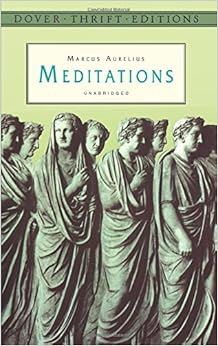


One of the world's most famous and influential books, Meditations, by the Roman emperor Marcus Aurelius (A.D. 121–180), incorporates the stoic precepts he used to cope with his life as a warrior and administrator of an empire. Ascending to the imperial throne in A.D. 161, Aurelius found his reign beset by natural disasters and war. In the wake of these challenges, he set down a series of private reflections, outlining a philosophy of commitment to virtue above pleasure and tranquility above happiness.Reflecting the emperor's own noble and self-sacrificing code of conduct, this eloquent and moving work draws and enriches the tradition of Stoicism, which stressed the search for inner peace and ethical certainty in an apparently chaotic world. Serenity was to be achieved by emulating in one's personal conduct the underlying orderliness and lawfulness of nature. And in the face of inevitable pain, loss, and death — the suffering at the core of life — Aurelius counsels stoic detachment from the things that are beyond one's control and a focus on one's own will and perception.Presented here in a specially modernized version of the classic George Long translation, this updated and revised edition is easily accessible to contemporary readers. It not only provides a fascinating glimpse into the mind and personality of a highly principled Roman of the second century but also offers today's readers a practical and inspirational guide to the challenges of everyday life.

Series: Dover Thrift Editions
Paperback: 112 pages
Publisher: Dover Publications (July 11, 1997)
Language: English
ISBN-10: 048629823X
ISBN-13: 978-0486298238
Product Dimensions: 5.5 x 0.3 x 8.2 inches
Shipping Weight: 3.2 ounces (View shipping rates and policies)
Average Customer Review: 4.3 out of 5 stars See all reviews (1,077 customer reviews)
Best Sellers Rank: #1,322 in Books (See Top 100 in Books) #1 in Books > Biographies & Memoirs > Historical > Europe > Rome #1 in Books > Textbooks > Humanities > History > Ancient #2 in Books > Literature & Fiction > Ancient & Medieval Literature > Ancient & Classical

One should have more than one translation for Meditations. Note this difference between Maxwell Staniforth's translation in 1964 (Penguin Classics) and Hay's 2002 translation in these two passages.1964: When force of circumstance upsets your equanimity, lose no time in recovering your self-control, and do not remain out-of-tune longer than you can help. Habitual recurrence to the harmony will increase your mastery of it.2002: When jarred, unavoidably, by circumstances, revert at once to yourself, and don't lose the rhythm more than you can help. You'll have a better grasp of the harmony if you keep going back to it.-----------------1964: Adapt yourself to the environment in which your life has been cast, and show true love to the fellow-mortals with whom destiny has surrounded you.2002: The things ordained for you - teach yourself to be at one with those. And the people who share them with you - treat them with love. With real love.------------------The 1964 version is regal, while the 2002 (Hays') version is Aurelius writing, quickly, in a spiral notebook while on horseback, the equivalent of "memo to myself."Reading this book is like taking a cold shower, or visiting a favorite bartender, who insists on serving you coffee, not drink. Hays has brought us a Marcus Aurelius who puts his hand on your shoulder, looks you in the eye, and tells you like it is: Get over yourself. You can't change the world. Do your best and realize you are of this earth. Human experience is muddy, so what? This book is best read in tough times, when you could use a little steel in your spine.
I don't know who did the translation for this one but I found it very difficult to follow. This prompted me to look around and I found another translation by George Long (Thoughts of Marcus Aurelius Antoninus 1862). Even though it's not a recent translation, Long's version is often easier to understand. Compare the translations of the first paragraph for example:This version:Of my grandfather Verus I have learned to be gentle and meek, and to refrain from all anger and passion. From the fame and memory of him that begot me I have learned both shamefastness and manlike behaviour. Of my mother I have learned to be religious, and bountiful; and to forbear, not only to do, but to intend any evil; to content myself with a spare diet, and to fly all such excess as is incidental to great wealth. Of my great-grandfather, both to frequent public schools and auditories, and to get me good and able teachers at home; and that I ought not to think much, if upon such occasions, I were at excessive charges.George Long's version:From my grandfather Verus I learned good morals and the government of my temper. From the reputation and remembrance of my father, modesty and a manly character. From my mother, piety and beneficence, and abstinence, not only from evil deeds, but even from evil thoughts; and further, simplicity in my way of living, far removed from the habits of the rich. From my great-grandfather, not to have frequented public schools, and to have had good teachers at home, and to know that on such things a man should spend liberally.Having said this however, it's still worth comparing both translations which are free on the Kindle.
Other reviewers here have commented about the work itself, so I would just add a note about this specific translation.One of the most difficult tasks for a reader interested in non-English language work (and works from classical times in particular) is to choose an appropriate translation. Of course, what counts as `appropriate' is somewhat subjective.What I was looking for was a translation that is clear and accurate; one that manages to convey something of a feeling for the both the person who wrote, and the times they wrote in. In this Staniforth excels.Unlike say, the Benjamin Jowett translation of Plato which (at least to my ears) has a distinctly Victorian ring, or the popular new age paraphrases of many of the Stoics (and in truth they are paraphrases or adaptations rather than translations), to me Staniforth (whose translation dates from 1964) strikes just the right balance.The words of Marcus Aurelius are rendered intelligibly and with a dignity and awareness of the historical context. The reader is neither forced to re-read and ponder (i.e., speculatively re-translate), nor wince at inappropriate colloquialisms of 21st century English. Better still, one can immediately perceive and appreciate the times in which the work was written. No mean accomplishment, to say the least.Of course, each reader needs to make this judgment for themselves. provides an excellent (and free) way of doing this with its `search inside this book' feature, which is enormously useful for anyone making this decision.
The style is direct and unpretentious. The message is simple but extraordinarily powerful: life is short, the past and the future are inaccessible, pain and pleasure have no meaning, but inside each one of us there is a ruling faculty that is touched only by itself. Only that which makes us better capable of confronting our condition with resolution and courage can be said to be good, and only that which makes us worse and more unsatisfied can be said to be bad. The only thing that is of any importance is our own private quest for perfection, which no external power can ever destroy. Marcus Aurelius delivers many insightful and inspirational observations about human nature and the human condition, and he makes an excellent rational argument for seeking the good and for acting modestly and continently. I cannot think or a more satifying and moving work, and it is all the more poignant because it was written by a man who wielded almost absolute power and lived surrounded by the luxury, yet managed to keep things in perspective and to occupy himself only with what truly matters. One sentence captures perfectly the spirit of his writings: "Where a man can live, there he can also live well." An extraordinary testimony of wisdom and fortitude.

Meditations (Dover Thrift Editions) Poetics (Dover Thrift Editions) The Autobiography of Benjamin Franklin (Dover Thrift Editions) A Christmas Carol (Dover Thrift Editions) The Canterbury Tales (Dover Thrift Editions) The Inferno (Dover Thrift Editions) Dark Night of the Soul (Dover Thrift Editions) Running a Thousand Miles for Freedom: Or, the Escape of William and Ellen Craft from Slavery (Dover Thrift Editions) The Federalist Papers (Dover Thrift Editions) Walden; Or, Life in the Woods (Dover Thrift Editions) Self-Reliance and Other Essays (Dover Thrift Editions) Selected Writings and Speeches of Marcus Garvey (Dover Thrift Editions) History's Greatest Speeches (Dover Thrift Editions) Great Speeches of the 20th Century (Dover Thrift Editions) Great Speeches by Native Americans (Dover Thrift Editions) Abraham Lincoln: Great Speeches (Dover Thrift Editions) The Strenuous Life: Essays and Addresses (Dover Thrift Editions) Infamous Speeches: From Robespierre to Osama bin Laden (Dover Thrift Editions) You Know Me Al (Dover Thrift Editions) Narrative of Sojourner Truth (Dover Thrift Editions)
