
Free Downloads SuperFreakonomics
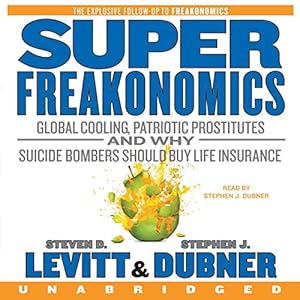


Freakonomics lived on the New York Times bestseller list for an astonishing two years. Now authors Steven D. Levitt and Stephen J. Dubner return with more iconoclastic insights and observations in SuperFreakonomics—the long awaited follow-up to their New York Times Notable blockbuster. Based on revolutionary research and original studies SuperFreakonomics promises to once again challenge our view of the way the world really works. --This text refers to an out of print or unavailable edition of this title.

Audible Audio Edition
Listening Length: 7 hours and 28 minutes
Program Type: Audiobook
Version: Unabridged
Publisher: HarperAudio
Audible.com Release Date: October 20, 2009
Language: English
ASIN: B002TNABPK
Best Sellers Rank: #20 in Books > Audible Audiobooks > Business & Investing > Economics #66 in Books > Audible Audiobooks > Nonfiction > Reference #105 in Books > Humor & Entertainment > Pop Culture > General

I had to laugh as I read some of the negative reviews. Listen people, it's not intended to be a TEXTBOOK, nor is it written like one, thankfully. I've read both books. Super Freakonomics is a good exercise in critical thinking (something that is becoming sorely lacking in the age of American Idol, thanks to our putrid public schools and Playstation parenting); it makes you think about a lot of "truths" that we take for granted. For example, this book actually made me change some of my thinking about global warming. The book is super-interesting, and full of information that you'd be hard-pressed to find in your typical daily reading; and, it "sexes-up" the fields of microeconomics and behavioral economics. One of the points (relentlessly made) is how we (especially our governments) seem to prefer complex, costly solutions to problems, when cheaper, simpler solutions often exist, and the book does a great job of providing many examples of this. Is it a definitive tome on the many topics it covers? No - again, it's not a textbook, but it was definitely worth the time I spent reading it - I hated putting it down.
Superfreakonomics is the follow-up to the wildly successful Freakonomics, which I thoroughly enjoyed. This edition is more of the same. If you liked the first one, you'll like this one. If you didn't, then you probably won't. If you haven't read either, read the first one. This one is interesting, mostly, but the last chapter was a bit of a drag for me. There are some fascinating theories, statistics and illustrations. For the fans of their New York Times blog, however, there's not much that's new. The first book was a novelty, and a fascinating interdisciplinary one. This book is clearly a concerted effort, and it's enjoyable, but I recall random trivia and interesting points rather than the overarching themes. Did I enjoy it? Absolutely. Will I still talk about it at dinner parties in five years as I still talk about some of the theories in the first one? Well, I will reference one specific chapter.In short, I loved it, although not quite as much as the first one.
I gave a positive review to the first Freakonomics. That book distilled some 10 years of academic research by Mr. Levitt, and it was already stretched a bit thin. Levitt does not have another 10 years of research to convert into a second book, so instead we get a collection of magazine articles with cutesy "counterintuitive" angles to them. I know a popular book like this can't be expected to be completely rigorous, but what I've learned about Levitt since the first book has left me less willing to take him at face value. For example his famous study of the link between abortion and crime was later shown to suffer from a programming error in which he neglected to properly normalize a series of crime statistics. When the error was corrected, the trumpeted correlation went away. Levitt responded by re-jiggering his assumptions in a complicated way so he could keep his original conclusions intact. He certainly doesn't make his readers aware of how much subjectivity is in his analysis, and he gives short shrift to legitimate alternate interpretations. Without the penumbra of credibility Levitt enjoyed from his work in econometrics, he's just another moderately amusing magazine writer who shouldn't be taken too seriously.
I thoroughly enjoyed this book. It sheds light on why I bothered studying for a degree in economics at university. Yes, economics can be fun. It's a pity it gets such a bum rap. Why should it be called the "dismal science"?Steven Levitt and Stephen Dubner have written an amusing and readable book. It's full of anecdotes and whimsical stories without ever seriously veering from the science of microeconomics which is its basis. The two Steves have researched an array of topics from street prostitution, to hospital deaths in the 19the century before opining upon global warming and how it might be resolved if, indeed, it is a problem. It's this final point that I particularly loved. Global warming has become a modern religion. It has its own dogmas and turns a blind eye to anyone who questions the "rules". I am quite confident that, in due course, global warming will be solved but it won't be by the naïve and cack handed solutions that greens put forward. It will be economics that comes to the rescue. This has always been the history of the world and I see no reason why this should change now.Perhaps the most pleasant feature of "SuperFreakonomics" (and its predecessor "Freakonomics") is that it brings economics away from the realm of stuffy ivory towered professors and their arcane theories and formulas. Instead, economics is presented as something to enjoy. This is the book's real strength. I can only hope that this technique has introduced economics to a wider audience.However, before finishing up, I find myself wondering which of the "case studies" amused me the most. I think it was the story about travel in New York City and how horses caused more deaths per capita than cars. It's ironic then that the car is seen as the work of the devil by some when, in fact, it has been a great liberator of the human race. Yes, "SuperFreakonomics" is a great read. Read it and enjoy.

SuperFreakonomics SuperFreakonomics: Global Cooling, Patriotic Prostitutes, and Why Suicide Bombers Should Buy Life Insurance SuperFreakonomics, Illustrated edition: Global Cooling, Patriotic Prostitutes, and Why Suicide Bombers Should Buy Life Insurance
