
Free Downloads Essential Linguistics: What You Need To Know To Teach Reading, ESL, Spelling, Phonics, And Grammar
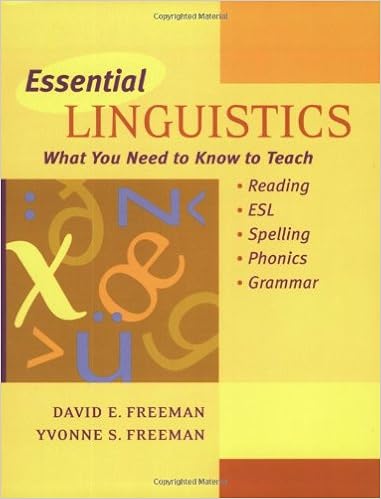


Linguistics is much more than a study reserved for academicians. Linguistics has real-life applications to effective teaching–now more than ever. With the increased emphasis on phonemic awareness and phonics in the teaching of reading, teachers need to understand how language works. When teachers are familiar with basic linguistic concepts, they are better prepared to make decisions about how to teach reading, spelling, phonics, and grammar to all students, including English language learners.

Paperback: 263 pages
Publisher: Heinemann; 1 edition (January 14, 2004)
Language: English
ISBN-10: 0325002746
ISBN-13: 978-0325002743
Product Dimensions: 7.4 x 0.6 x 9.1 inches
Shipping Weight: 1.1 pounds
Average Customer Review: 4.2 out of 5 stars See all reviews (32 customer reviews)
Best Sellers Rank: #168,474 in Books (See Top 100 in Books) #275 in Books > Textbooks > Humanities > Linguistics #467 in Books > Politics & Social Sciences > Social Sciences > Linguistics #494 in Books > Education & Teaching > Schools & Teaching > Early Childhood Education

Freeman & Freeman have hit a great niche with their book. I don't want or need, a complex linguistics book in the style of Chomsky. Freeman & Freeman take language research and package the relevant "real-world" findings so they will be of use for teachers. Although my interest is for English as a Second (ESL) teachers, I believe every teacher is concerned with literacy, and Freeman & Freeman's book covers what teachers need to know concerning phonics v. whole word instruction, spelling, and grammar. Freeman & Freeman seem to belong to the Stephen Krashen school of language and reading. This is a plus for me, but for Krashen-haters, it probably wouldn't be, and they should look elsewhere. This is "baby" linguistics book--you won't get a section on Chomsky's generative grammar here. I think it would be a good companion volume along with VanPatten's "From Input to Output"--which is a slim volume solely concerned with second language acquisition and has the same conversational tone--and--this is important--their teaching advice and philosophy meshes.
I picked up this book from a university bookstore because I was interested in background knowledge in linguistics to help guide reading instruction. This book is a typical "we are right (whole language) and you are wrong (phonics)" debate. The authors refer to themselves as "sociopsycholinguists" which I took to be the new term for whole language teachers. I don't want to waste my time reading about the whole language vs. phonics debate anymore, I just wanted the research and background provided by linguistic study. This book just seemed to be a rehashing of whole language theories; and why they are correct and the phonics approach is wrong with little classroom strategies (which is what I wanted from the book). I wanted different ways I could use to help struggling readers no matter what the theory, I don't feel this was a good book for that.
Not really impressed with this book. It was a required text and I've been disappointed in it's content. When discussing the why we use sound to communicate, the best the authors could come up with is "..to talk in the dark and to talk around corners." The authors present stronger material in working with ELL students but weak on linguistics. As a textbook, this a bad choice as a teaching source. The up & coming ELL teachers should look for other material.
This was a required text for the graduate course I was taking on Linguistics. It is very poorly written. It is a small book full of trivia. I learned close to zero about a topic that I had a burning desire to learn about. There is a lot of nebulous advice about what not to do, but very little about what to do for students. Now I know the origin of the word "sandwich." This kernel of information will be great to talk about during the next happy hour that I attend! If you want to really learn about linguistics I would highly recommend linguistic books by the author Edward Finegan's book instead.Do yourself a favor and walk away...And please college professors, don't dumb down our courses by making graduate students read stuff like this... It's pathetic!
Although it purports to take a balanced view of the field, Essential Linguistics is breathtakingly biased and out of date. The authors are rabid whole language propagandists who repeatedly champion thoroughly discredited Krashen [...] theories to argue against mountains of evidence supported by the NCTE that learners need 20 minutes of daily phonemic awareness activities to learn decoding skills and benefit from formal grammar instruction. Disingenuously, the Freemans quote a 1963!report by the NCTE that there is "widespread agreement that the teaching of formal grammar... has a negligible....or even harnmful effect on the improvement of writing," while neglecting to mention that the most recent 2001 report is anathema to their central arguments. The rest of the book is equally misleading. Universal grammar is not a consensus view, but "has been for some time, a completely empty concept" [...] Common sense and any ESL teacher will tell you that students who are learning English as a second language actually do need to practice speaking and writing it to learn how to gain proficiency (see Swain-Comprehensible Output)and there is no one in the entire world who still takes the "word recognition" strawman view of reading that the authors spend most of the text railing against. Last in vogue just after WWII, it is not, contrary to the Freemans, one of todays "two current views of reading."Shame on the Freemans for completely misrepresenting the field!I feel sorry for the English lanaguage learners who have teachers who buy into their counterproductive practices.
The authors of this book write from a very subjective point of view. I was very disappointed in this book as we're my classmates and professor who had used this book for the first time. He is currently looking for a different textbook to use for his next class. They present that Whole Language is the only reasonable approach to teaching reading and writing. They do not show the other possible methods.
Essential Linguistics: What You Need to Know to Teach Reading, ESL, Spelling, Phonics, and Grammar was a required textbook for my Applied Linguistics Class in graduate school. Still to this day, I feel that my professor picked the most valuable and the most informational textbook when she chose this book for our class. How are words even words in the English language? How do we dissect our native language? How do we breakdown English for someone who is brand new to the language? All these answers and many more answers to many more questions can be located in this book. On , I didn't even pay half of the price for this book that my college bookstore was asking for. I still use this book as an educator today. The book was in the mailbox just days after it was purchased and was in such great used condition that it indeed looked like a new book.

Essential Linguistics: What You Need to Know to Teach Reading, ESL, Spelling, Phonics, and Grammar Essential Linguistics, Second Edition: What Teachers Need to Know to Teach ESL, Reading, Spelling, and Grammar The Four Seasons ~ Spelling Time ~ Master 150 Spelling Words Through Art & Logic: Do-It-Yourself Spelling Games For Elementary Students (Charity's Fun-Spelling Collection) (Volume 1) Hooked on Phonics Learn to Read - Levels 5&6 Complete: Beginning Phonics (Emergent Readers | First Grade | Ages 6-7) (Hooked on Phonics: Learn to Read Complete) Contemporary Corpus Linguistics (Contemporary Studies in Linguistics) Speed Reading: The Ultimate Speed Reading Course to Increase Your Reading Speed (speed reading techniques, speed reading for beginners, speed reading training) (Genius Guide: Step By Step Book 3) Phonics Pathways: Clear Steps to Easy Reading and Perfect Spelling Fifty Ways to Teach Them Grammar: Tips for ESL/EFL Teachers Week-by-Week Phonics Packets: 30 Independent Practice Packets That Help Children Learn Key Phonics Skills and Set the Stage for Reading Success I Love My Dad (English Korean bilingual, Korean children books, Korean kids books, ESL for Koreans) korean english books, bilingual children, ESL for kids (English Korean Bilingual Collection) Essential Portuguese Grammar (Dover Language Guides Essential Grammar) Teach Me Korean & More Korean: 2 Pack (Teach Me) (Teach Me... & Teach Me More... 2-Pack) (Korean Edition) Alfred's Teach Yourself to Play Mandolin: Everything You Need to Know to Start Playing Now! (Teach Yourself Series) Alfred's Teach Yourself to Play Mandolin: Everything You Need to Know to Start Playing Now!, Book, CD & DVD (Teach Yourself Series) Alfred's Teach Yourself to Play Harmonica: Everything You Need to Know to Start Playing Now!, Book & Harmonica (Teach Yourself Series) Alfred's Teach Yourself to Play Harmonica: Everything You Need to Know to Start Playing Now! (Teach Yourself Series) Spelling 1 - 2: Over 2,000 Spelling Words Everything You Need to Know About Snakes (Everything You Need Know) Everything You Need To Know About Geography Homework (Evertything You Need To Know..) NCLEX-RN Drug Guide: 300 Medications You Need to Know for the Exam (Kaplan Nclex Rn Medications You Need to Know for the Exam)
